A lightning bolt doesn’t have to hit your building to damage it. It can strike a transmission line a kilometre away, and within a fraction of a second, a voltage spike is travelling through your wiring, looking for the weakest thing to destroy. It might be the inverter. It might be the router, or the drive on your production line. That’s why surge protection devices exist, and most people only learn about them after something expensive has already failed.
Let’s look at what these devices do, where they matter, and how to choose the right one without overspending or under-protecting.
What Actually Happens During a Power Surge
A surge is a short, sharp rise in voltage, often lasting only microseconds. Your equipment is built for 230V (single phase) or 415V (three phase), and it can tolerate small deviations. It cannot tolerate a spike several times higher than its rating.
Here’s what most people don’t realise: lightning is the dramatic cause, but not the most common one. In our experience, the everyday culprits are far quieter:
- Large motors, compressors and pumps switching on and off
- Grid switching and load changes by the utility
- DG set changeovers
- Faults elsewhere on the same network
Each of these can push a small transient through your wiring. One spike rarely kills anything outright. But repeated hits slowly degrade insulation and electronic components, which is why equipment sometimes “just stops working” after a couple of years with no obvious reason.
What Surge Protection Devices Actually Do
Think of a surge protection device (SPD) as a pressure relief valve for electricity. It sits in your distribution board, watches the voltage, and stays invisible until a spike arrives. The moment voltage crosses a threshold, it diverts the excess energy safely to earth and clamps the voltage to a level your equipment can survive. Once the surge passes, it goes back to being invisible.
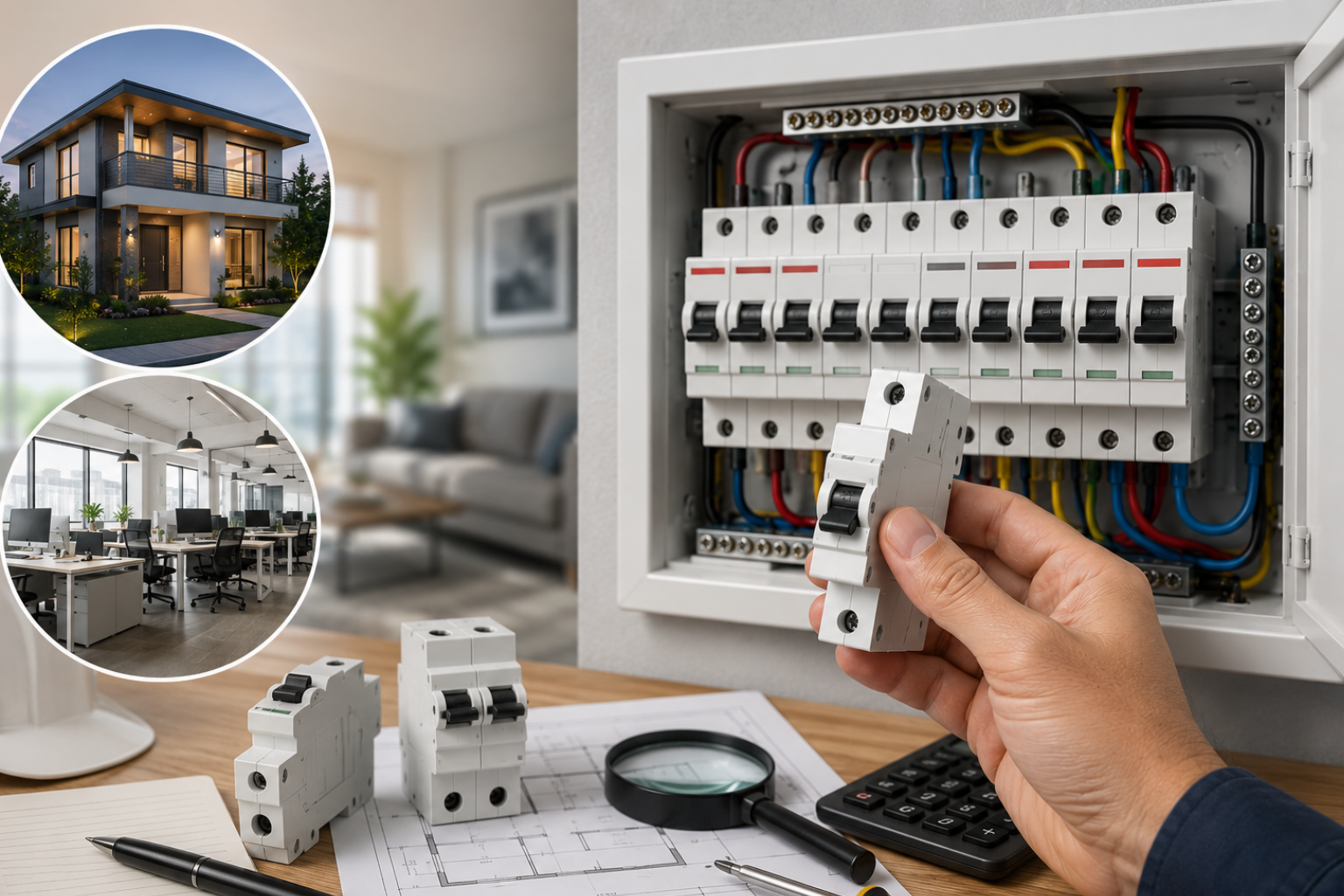
One clarification, because this confuses many buyers: an SPD is not a replacement for your MCB, MCCB or RCCB. Those protect against overloads, short circuits and leakage. An SPD protects against transient overvoltage. They do different jobs, and a properly protected panel has both.
Understanding the Types: Type 1, Type 2 and Type 3
Surge protection devices are classified by where they sit in the installation and how much energy they can handle.
Type 1 devices go at the incoming point, typically where the supply enters the building. They’re designed for direct or near-direct lightning currents and are tested with a heavy 10/350 µs waveform. If your building has an external lightning protection system, or is in an exposed location, consider this level.
Type 2 devices sit in the main or sub-distribution boards. They handle the residual surges that get past the first stage, along with switching surges from inside the network. For most homes, offices and commercial buildings, this is the workhorse.
Type 3 devices are installed close to the equipment itself, such as a sensitive server rack, a control panel or a medical device. They provide the final layer of “fine” protection.
In serious installations, these are used together in stages. Each stage absorbs some energy so the next one doesn’t have to.
Do Indian Homes Need Surge Protection Devices?
Honestly, it depends on where you live and what you plug in.
If your home has an air conditioner, an inverter with batteries, a modern refrigerator, a smart TV and a home office setup, then you have thousands of rupees of sensitive electronics on one supply line. Add the monsoon lightning that Mumbai, the Konkan belt and much of India see every year, plus voltage fluctuations from ageing local networks, and the case gets stronger.
For an independent house, a villa, or any building on an upper floor or open plot, we’d say a Type 2 SPD in the main distribution board is cheap insurance. The device costs a fraction of one replaced air conditioner. For a flat in a large complex with a well-earthed building system, the risk is lower, but it’s still worth asking your society about protection at the main panel.
Do Factories and Commercial Units Need Them?
Here the answer is much simpler: yes.
Industrial loads are exactly what SPDs are made for. VFDs, PLCs, servo drives, CNC controllers, sensors and SCADA systems are extremely sensitive to overvoltage. And the true cost of a surge in a factory is rarely just the damaged component. It’s the stopped line, the missed dispatch, the technician’s callout and the days waiting for a spare.
Factories also generate their own surges. Large motors starting, capacitor bank switching, welding equipment and DG changeovers all inject transients into the same network that feeds your control systems. In our experience, many “mystery” breakdowns in industrial plants trace back to this internal noise, not weather.
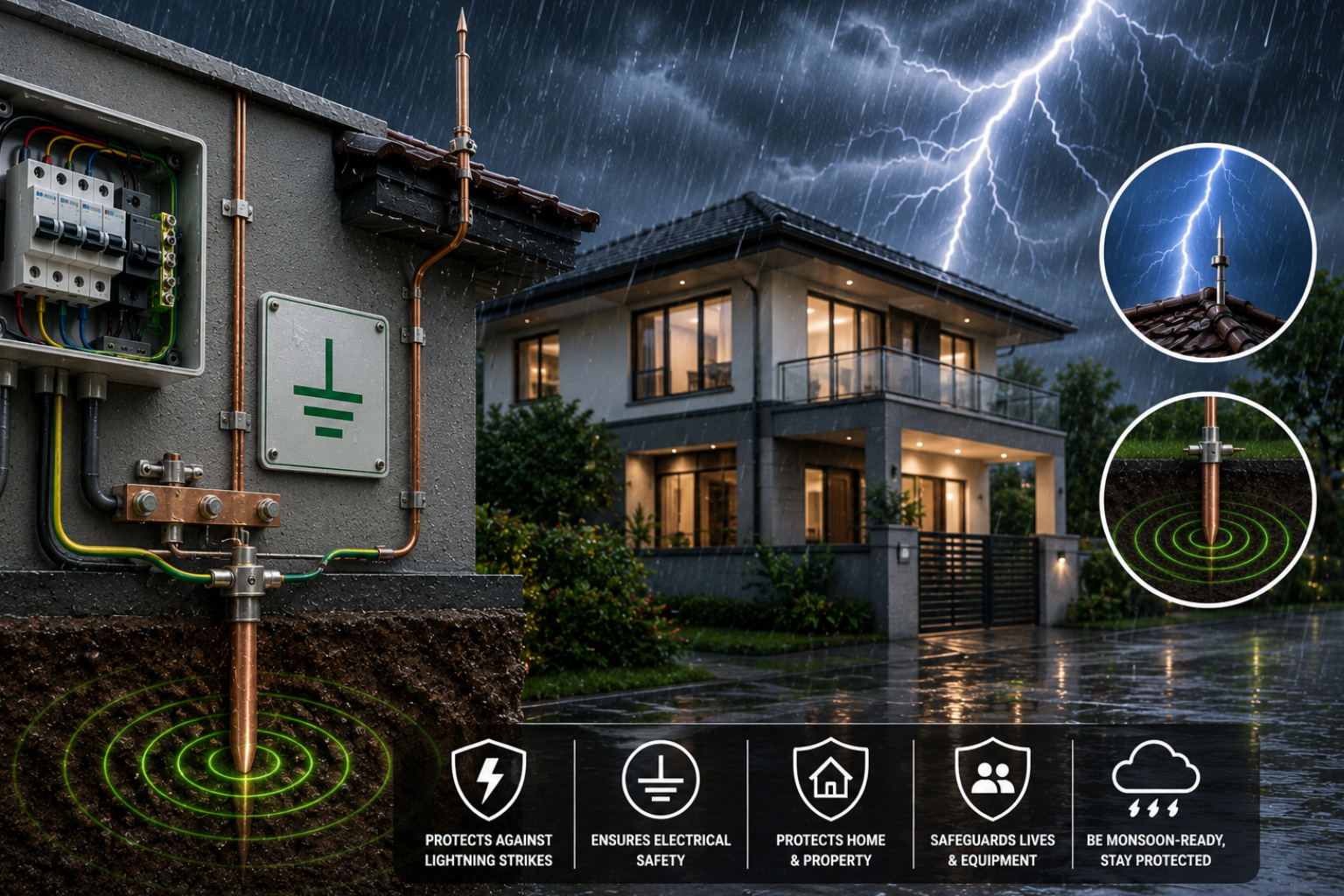
If the site has a lightning protection system on the roof, coordinated SPDs become even more important. Lightning current that’s been safely carried down the conductor still raises the earth potential and induces voltage in nearby cabling.
How to Choose the Right Surge Protection Device
Don’t buy on price alone, and don’t buy on the biggest number on the box either. Here’s what to check:
- Voltage rating (Uc). This is the maximum continuous voltage the device can sit at without conducting. It must be above your normal supply voltage with margin, or the device will wear out early.
- Voltage protection level (Up). This tells you how high the voltage can still get once the SPD acts. Lower is better, because it’s the level your equipment actually experiences.
- Discharge capacity (kA). Higher isn’t always smarter. Match it to the exposure: a sub-board in a city office doesn’t need the same rating as an incoming panel on an exposed industrial site.
- The right type for the location. Type 1 at the service entrance, Type 2 in distribution, Type 3 at the sensitive load.
- Compliance. Look for IEC 61643-11 testing and proper certification. An untested surge protection device is just a box in your panel.
- Status indication and backup protection. A good SPD shows when it has reached end of life, and it should be paired with the recommended backup fuse or MCB so a failing device doesn’t become a fault itself.
The Mistake That Makes Most SPDs Useless
Here’s where things get interesting. You can install the best device on the market and still get almost no protection if the earthing is poor.
An SPD works by sending surge energy to earth. If the earth connection is high-resistance, corroded or badly routed, that energy has nowhere to go, and it finds another path through your equipment. Lead length matters too. Long, looped connecting cables between the SPD and the busbar add impedance, raising the voltage your equipment sees.
Keep the connections short and straight, and test your earth pits regularly. Treat earthing and surge protection as a single system, not two purchases.
A Small Investment Against a Very Large Failure
Surges are unpredictable, but the damage is not. It hits the equipment you can least afford to lose, at the time you can least afford the downtime. Well-chosen surge protection devices, correctly installed and properly earthed, remove most of that risk for a modest one-time cost.
If you’re not sure which type suits your home, panel or plant, that’s a conversation worth having before the next monsoon, not after it. Eurogrid’s range of circuit protection devices and cable, earthing and lightning protection accessories is built for exactly this kind of system-level thinking, and our team can help you match the right protection to your installation. Reach out with your load details, and we’ll help you work out what you actually need.