Most electrical accidents don’t happen because systems lack earthing.
They happen because earthing is done incorrectly, and everyone assumes it’s fine.
In our experience, earthing is one of the most misunderstood and poorly executed aspects of electrical design. It’s treated as a formality at the end of a project rather than a core safety system. We’ve seen installations with expensive switchgear, advanced protection devices, and smart controls rendered unsafe because the earthing was poorly designed, poorly executed, or never tested after installation.
This article focuses on real-world earthing mistakes, why they happen, how they quietly increase risk, and, most importantly, how to avoid them. Not theory. Not textbook diagrams. The mistakes that actually cause failures on-site.
Why Earthing Failures Are More Dangerous Than Most Electrical Faults
A short circuit usually announces itself.
A failed breaker trips.
A surge damages equipment.
But earthing failures are silent.
Poor earthing doesn’t stop the system from working. It allows it to keep running in an unsafe state until the day it no longer does.
We’ve seen earthing-related issues lead to:
- Repeated equipment failures with no obvious cause
- RCDs that never trip when they should
- Dangerous touch voltages on panels and enclosures
- Fires caused by fault currents that had nowhere to go
This is why earthing mistakes are especially dangerous: they disable safety mechanisms without triggering alarms.
Earthing Mistake #1: Treating Earthing as a Single Rod in the Ground
This is the most common and most damaging earthing mistake.
Many installations still believe:
“We’ve installed an earth pit, so earthing is done.”
That’s not earthing. That’s a symbolic gesture.
Why This Fails
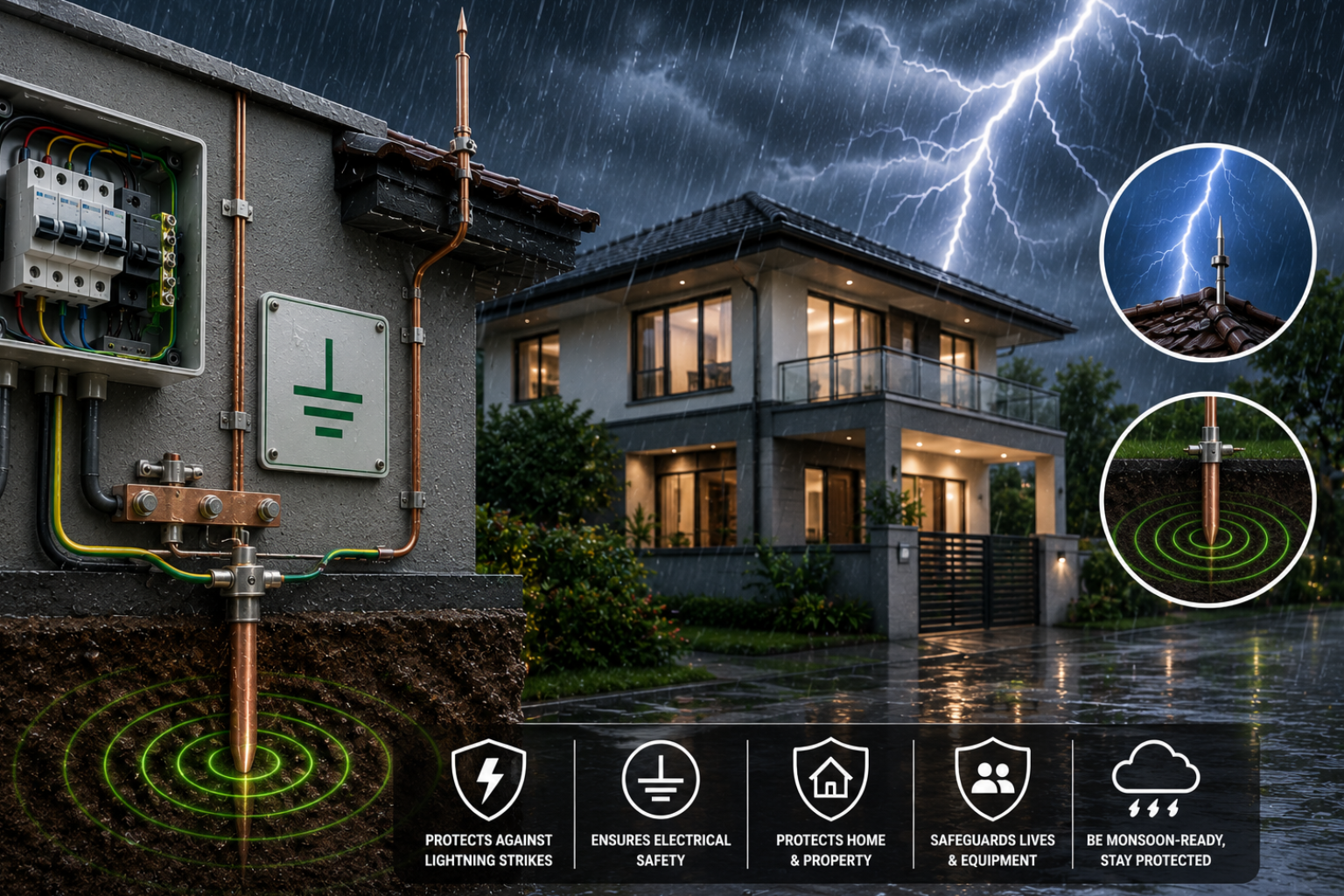
Earthing is not about placing a rod in soil. It’s about:
Creating a low-impedance fault path
Ensuring consistent potential across equipment
Enabling protective devices to operate correctly
A single rod with high earth resistance cannot:
Clear fault currents effectively
Stabilise system voltage
Protect sensitive equipment
How to Avoid It
Design earthing as a network, not a point
Use multiple electrodes where required
Ensure bonding between all conductive parts
Manufacturers like Eurogrid emphasise system-level earthing compatibility because protection devices depend on it to function correctly.
Earthing Mistake #2: Ignoring Soil Conditions Entirely
We’ve seen identical earthing designs copied across sites with completely different soil characteristics.
This never works.
Why Soil Matters More Than Hardware
Soil resistivity varies drastically based on:
Moisture content
Temperature
Chemical composition
Seasonal changes
An earthing system that performs well in one location can be nearly useless in another.
How to Avoid It
Conduct soil resistivity testing before design
Adjust electrode type, depth, and quantity accordingly
Re-test after installation, not just at commissioning
In practice, earthing performance depends more on soil than on copper size.
Earthing Mistake #3: Poor or Missing Equipotential Bonding
Earthing and bonding are often confused, and bonding is usually ignored.
What We See on Sites
Cable trays are not bonded
Structural steel left floating
Panel doors are not bonded to enclosures
Pipework isolated from earth
Each of these creates potential differences that are hazardous under fault conditions.
Why This Is a Serious Risk
When a fault occurs:
Different metal parts rise to different voltages
Touch voltage becomes lethal
Protective devices may not operate
Earthing without bonding is incomplete protection.
How to Avoid It
Bond all exposed conductive parts
Maintain continuity across joints and hinges
Treat bonding as a safety system, not an accessory
Earthing Mistake #4: Using Undersized or Improper Earth Conductors
This mistake usually comes from cost-cutting or rule-of-thumb practices.
Why Conductor Size Matters
Earth conductors must:
Carry fault current safely
Withstand thermal stress
Maintain mechanical integrity
Undersized conductors may not fail visibly, but they increase impedance, slowing fault clearance.
How to Avoid It
Size earth conductors based on fault current, not guesswork
Follow standards, but understand the intent behind them
Avoid mixing conductor materials without proper consideration
In our experience, earthing failures often occur during the fault, not before.
Earthing Mistake #5: Multiple Earths Without Coordination
Adding more earth points without planning doesn’t improve safety, it can reduce it.
Common Scenarios
Separate earth pits for different systems
Isolated equipment earthing
No common reference point
This creates circulating currents and potential differences.
Why This Is Dangerous
Fault currents split unpredictably
RCDs behave inconsistently
Equipment experiences stress voltages
How to Avoid It
Design a common earthing system
Maintain controlled separation only where required
Ensure clear documentation and labelling
Earthing must be coordinated, not duplicated randomly.
Earthing Mistake #6: Assuming RCDs Will Compensate for Poor Earthing
This is a dangerous assumption we encounter often.
The Reality
RCDs detect imbalance, not poor earthing.
If earthing impedance is high:
Fault current may be too low to trip
Touch voltage can still be dangerous
Fire risk remains
How to Avoid It
Treat earthing as the foundation
Use RCDs as an additional layer, not a substitute
Verify earth loop impedance during testing
Protection devices rely on earthing more than most people realise.
Earthing Mistake #7: No Testing After Installation
The most perfectly designed earthing system is useless if it’s never verified.
What We Commonly See
One-time testing at commissioning
No periodic measurements
No baseline data
Earthing degrades over time due to:
Corrosion
Soil changes
Mechanical damage
How to Avoid It
Record initial earth resistance values
Schedule periodic testing
Investigate gradual changes, not just failures
Good earthing is maintained, not installed and forgotten.
When NOT to Use Standard Earthing Approaches
This is where experience matters.
Standard earthing designs often fail in:
Data centers
Hospitals
Industrial plants with VFDs
High lightning-risk zones
These environments require:
Low-noise earthing
Dedicated clean earth systems
Enhanced surge coordination
Blindly applying “standard” earthing rules in specialised environments creates hidden risks.
A Practical Framework for Getting Earthing Right
In practice, effective earthing follows a clear sequence:
Understand the system risk – personnel safety, fire, and equipment
Study the site conditions – soil, environment, structure
Design earthing and bonding together
Coordinate with protection devices
Test, document, and maintain
Skipping any step compromises the entire system.
Eurogrid’s protection and distribution solutions are designed with this coordination in mind, because even the best protection device cannot compensate for poor earthing.
Why Earthing Is a System, Not a Component
The biggest earthing mistake of all is treating it as a checklist item.
Earthing:
Enables protective devices to work
Controls fault energy
Limits touch voltage
Reduces fire risk
Improves equipment reliability
When earthing fails, everything downstream is exposed.
Final Insight: Most Earthing Mistakes Are Invisible, Until They Aren’t
In our experience, earthing failures don’t announce themselves. They wait.
They wait until:
A fault occurs
A surge hits
Someone touches a panel
A fire investigation begins
Avoiding earthing mistakes isn’t about doing more; it’s about doing it intentionally, correctly, and verifiably.
When earthing is designed with the same seriousness as switchgear and protection, supported by quality components and system-level thinking from manufacturers like Eurogrid, it stops being an afterthought and becomes what it should be:
The foundation of electrical safety.