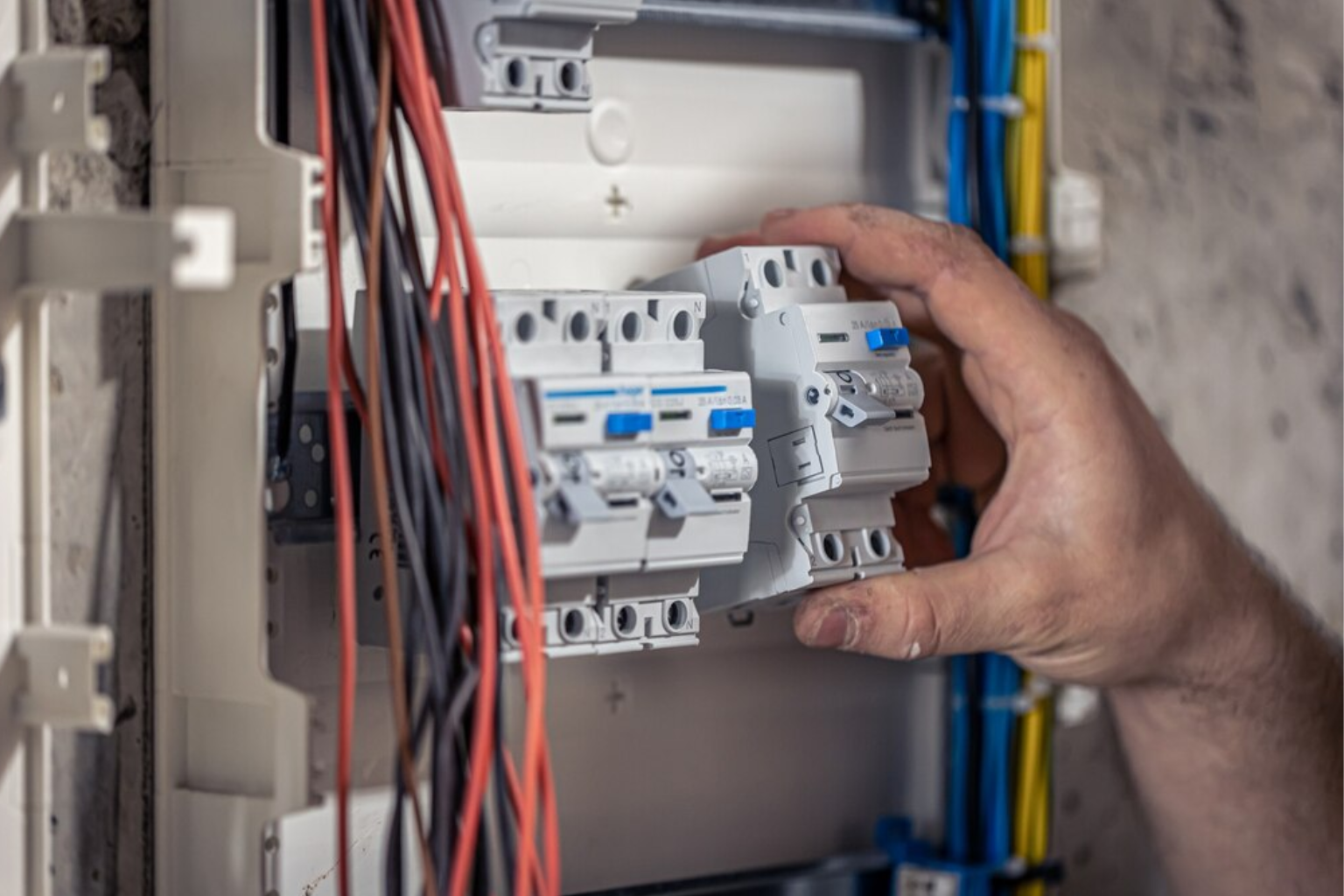
Pick up any electrical panel drawing, and you’ll see both of them, sometimes side by side, sometimes on entirely different floors of the same building. MCBs and MCCBs. They’re both circuit breakers. They’re both electrical protection devices. And yet, mixing them up, or worse, using one where the other belongs, is one of the most consequential mistakes you can make in an electrical installation.
This isn’t a trivial distinction. The difference between an MCB and an MCCB goes far beyond physical size. It’s a question of design philosophy, fault-handling capacity, application logic, and, ultimately, what stands between your electrical system and a catastrophic failure. Whether you’re specifying switchgear for an industrial facility or reviewing a distribution board upgrade, understanding this difference clearly will sharpen every decision you make downstream.
Starting From First Principles
Both an MCB (Miniature Circuit Breaker) and an MCCB (Moulded Case Circuit Breaker) are automatic switching devices. When current through a circuit exceeds a safe threshold due to an overload, a short circuit, or a fault, the circuit breaker interrupts the flow before damage occurs. That’s the shared mission.
Where they diverge is in how much they can handle, how precisely that protection can be configured, and where in the electrical system they belong. Think of an MCB as a sharp, efficient instrument designed for predictable, lower-current environments. An MCCB is the heavy-duty counterpart, built for industrial-scale currents, adjustable thresholds, and the kind of fault energy that a miniature device simply cannot absorb.
Worth noting
Neither device is universally “better.” The right choice depends entirely on the current rating, fault level, and application; using the wrong one in the wrong place can lead to either over-protection (nuisance tripping) or under-protection (genuine hazard).
The Core Technical Differences
Here’s where things get interesting. Most explanations of MCB vs MCCB stay at the surface: one is small, one is big. But the real differences sit in the specifications, and those specifications drive every application decision.
The Adjustability Factor: Why It Matters More Than Size
One of the most overlooked differences between these two circuit breakers is adjustability. An MCB’s trip characteristics are fixed at the point of manufacture. You buy a 16A Type C MCB, and it will always trip at that threshold. That’s perfectly suited to branch circuits where loads are predictable and consistent.
An MCCB, on the other hand, typically allows the engineer to adjust both the overload (thermal) and short-circuit (magnetic) trip settings. This matters enormously in industrial settings where motor loads, transformer inrush currents, and varying equipment demands mean no two circuits behave identically.
In our experience working with industrial installations, the ability to fine-tune an MCCB’s trip threshold is what separates nuisance tripping from intelligent, application-specific protection. A correctly adjusted MCCB protects the equipment it’s meant to protect, not just the cable feeding it.
Common Mistake
Specifying an MCB on a high-fault-level main feeder to save cost. If the prospective short-circuit current exceeds the MCB’s breaking capacity, the device won’t interrupt the fault safely; it may arc, rupture, or fail entirely. Always match breaking capacity to the available fault level at the point of installation.
Where Each Belongs: Application Logic
This is where the theory translates into practice. Understanding which protection device fits which installation isn’t guesswork; it follows a clear logic based on load size, fault exposure, and position in the electrical network.
MCB, Best Used For
- Residential & Light Commercial
- Home distribution boards
- Lighting circuits (Type B)
- AC, geyser, kitchen circuits (Type C)
- Office branch circuits
- Retail shop panels
- Final sub-circuits in commercial buildings
- MCCB, Best Used For
- Industrial & Heavy Commercial
- Main incoming feeders
- Industrial motor control panels
- Sub-main distribution in factories
- Generator and UPS protection
- Data centres & large HVAC systems
- High-rise building main switchboards
What most people don’t realise is that in a well-designed electrical system, MCBs and MCCBs aren’t competing; they’re working in hierarchy. The MCCB sits at the main distribution level, providing high-capacity protection and fault discrimination. MCBs protect the individual branch circuits downstream. Each device does its job precisely, without interfering with the other.
Breaking Capacity: The Specification You Cannot Ignore
Breaking capacity (also called short-circuit capacity, rated in kA) is the maximum fault current a circuit breaker can safely interrupt without damage to itself or the surrounding installation. It’s arguably the most critical specification when selecting between an MCB and an MCCB, and it’s where cheap or incorrectly specified devices fail catastrophically.
Standard MCBs are rated up to 10kA. For most residential and light commercial applications, this is adequate. But step into an industrial switchgear panel near a transformer or a main bus bar, and the available fault current can be 50 kA, 85 kA, or higher. An MCB placed in this environment isn’t a safety device; it’s a liability.
MCCBs are specifically engineered for these environments. Higher-frame MCCBs can handle fault currents well beyond what any miniature device can manage, with internal arc-quenching mechanisms designed to absorb the enormous energy released during a major fault event.
At Eurogrid, both our MCBs and MCCBs carry clearly marked breaking capacity ratings, because we believe that the engineer or installer reading that specification deserves to know exactly what they’re working with.
Tripping Characteristics: B, C, D Curves in MCBs vs Electronic
Trips in MCCBs
MCBs use thermal-magnetic tripping with standardised curves , Type B, C, and D , each calibrated for different levels of inrush current tolerance. A Type B trips faster under surge conditions, suited for resistive loads. Type C allows slightly higher inrush, better for motor loads. Type D is for equipment with very high starting currents.
MCCBs take this further. More advanced MCCBs incorporate electronic trip units that offer independently adjustable long-time, short-time, and instantaneous protection bands. This level of granularity allows protection engineers to coordinate devices across a network, ensuring that only the circuit closest to a fault trips, leaving the rest of the installation live. It’s called discrimination or selectivity, and it’s what separates a well-engineered power system from one that goes dark at the first fault.
Engineering Insight
Selectivity, ensuring the correct upstream or downstream device trips during a fault, is impossible to achieve reliably using only MCBs throughout a system. The combination of MCCBs at higher levels and MCBs at the branch level is what enables a properly coordinated protection scheme.
Installation and Maintenance Considerations
MCBs are compact, DIN-rail-mounted, and straightforward to install and replace. In a residential or light-commercial panel, an electrician can replace a faulty MCB in minutes. They’re also relatively low-maintenance; the expectation is that they’ll perform reliably throughout their rated service life without adjustment.
MCCBs require more careful installation. They’re bolted into the panel, often require lugged cable connections, and their adjustable settings should be set and verified by a qualified electrical engineer during commissioning. Periodic maintenance, checking for overheating, verifying trip settings, and testing operation are standard practices for industrial-level switchgear protection.
Neither device should be treated as “fit and forget” indefinitely, but the maintenance disciplines are different. MCCBs operating in demanding industrial environments deserve scheduled inspection as part of any facility’s electrical maintenance programme.
Making the Right Choice for Your System
The decision framework is actually simple once you apply it clearly. Start with three questions: What is the maximum continuous current the circuit will carry? What is the prospective short circuit current at that point in the network? Does the protection need to be fixed or adjustable?
If your current requirement is below 63A, fault levels are manageable, and loads are predictable, an MCB is your device. If you’re dealing with higher currents, greater fault exposure, motor loads, or a position in the network where adjustability and high breaking capacity matter, an MCCB is the correct choice.
The wrong answer is always defaulting to whichever is cheaper or more familiar without checking the specifications. Electrical protection devices earn their cost by performing precisely when everything else has gone wrong.
Eurogrid manufactures both MCBs and MCCBs as part of a comprehensive range of circuit protection devices and industrial switchgear, designed for consistent performance across residential, commercial, and industrial applications. Every product is built to international quality standards, with specifications clearly documented so that engineers, contractors, and procurement teams can make confident, informed decisions.
If you’re specifying protection devices for a new project or reviewing an existing installation, the Eurogrid team is available to assist with product selection and technical guidance. Getting the protection right at the design stage is always simpler and far less expensive than correcting it after commissioning.
Specify the Right Protection. Every Time.
Explore Eurogrid‘s range of MCBs, MCCBs, and industrial switchgear, or speak with our team for application-specific guidance.