Most people don’t think twice
about fans until they’re standing in a sweltering warehouse at 2 PM in May, or sitting in a stuffy office where the air simply refuses to move. That’s usually the moment the question comes up, and it’s a more important question than it sounds: Do I need an industrial fan or a commercial fan?
The two terms get used interchangeably all the time, especially online, and that’s where the confusion begins. Pick the wrong type, and you’re either massively overpowered for your space (and paying for it on every electricity bill) or severely underpowered, running fans that can’t handle the heat, the dust, or the sheer scale of what you need them to do.
Let’s break this down properly.
What Actually Separates Industrial and Commercial Fans?
At the core, the distinction comes down to three things: environment, load, and purpose.
Commercial fans are designed for occupied, relatively controlled spaces, such as offices, retail stores, hotels, restaurants, schools, hospitals, and showrooms. The air in these spaces needs to move, yes, but the primary goal is comfort. People are present. Noise matters. Aesthetics sometimes matter too. These fans are built to run reliably during business hours, handle moderate ambient temperatures, and blend into their surroundings without becoming an eyesore or a distraction.
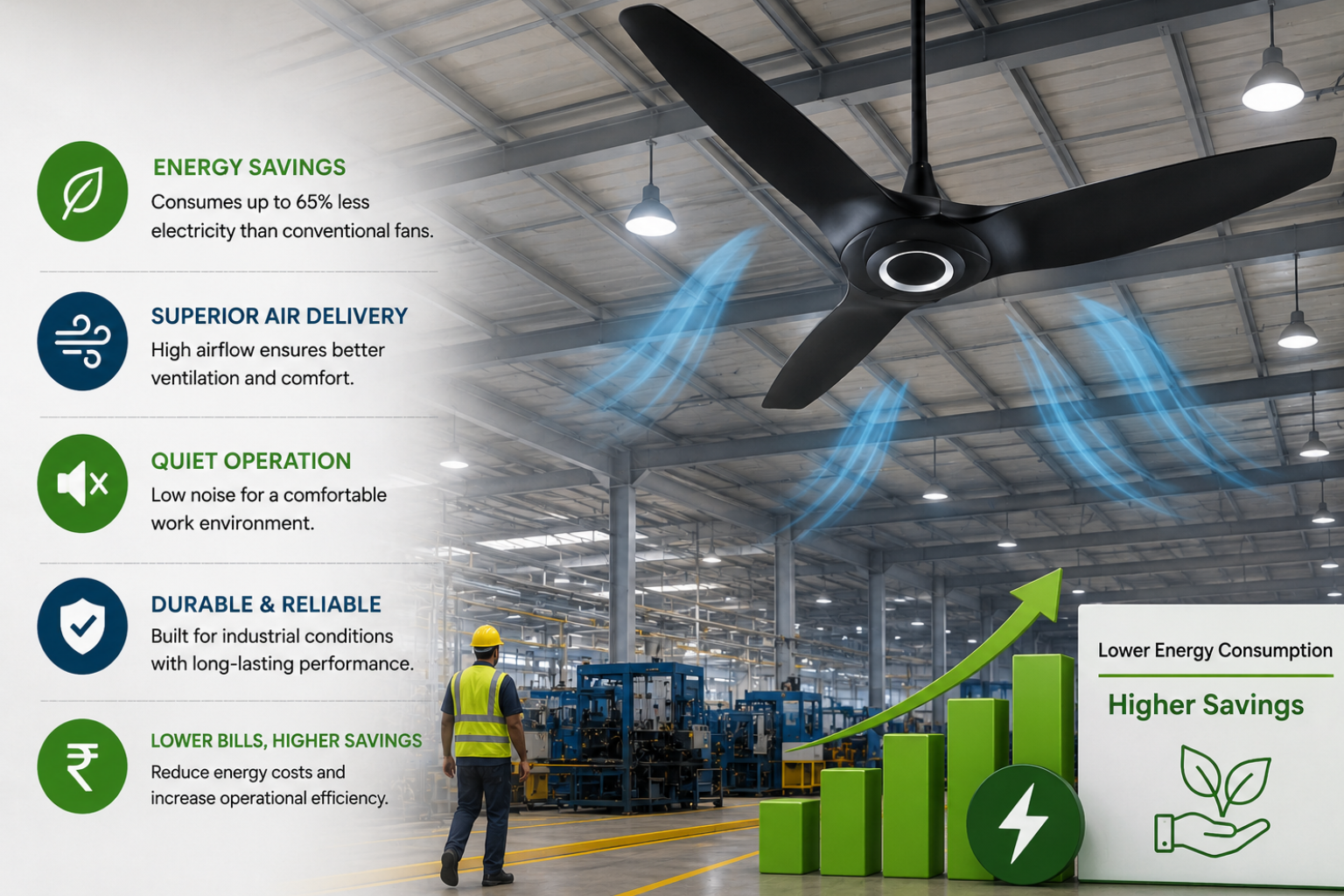
Industrial fans, on the other hand, are built for environments that would destroy a commercial fan within months. Factories, manufacturing plants, workshops, warehouses, foundries, and chemical facilities operate at higher temperatures, generate fumes, produce significant dust and particulate matter, and often run 24 hours a day. Industrial fans are engineered for continuous, heavy-duty operation under these conditions. Durability isn’t a feature; it’s the entire point.
Here’s where things get interesting: the line between industrial and commercial isn’t always about size. A large ceiling fan in an airport departure lounge is a commercial fan. A compact exhaust fan pulling fumes out of a chemical storage room is industrial. The classification is about what the fan is built to withstand, not simply how big it is.
Breaking Down the Key Differences
Motor Construction and Durability
Commercial fans typically use standard induction motors designed for intermittent or regular daily use. They’re efficient, reasonably quiet, and built to last a good number of years in clean-to-moderate environments.
Industrial fans use heavy-duty motors, often with higher IP (Ingress Protection) ratings, built to handle vibration, heat, corrosive air, and continuous operation without degradation. When you’re running a fan in a welding shop or a paint booth, the motor needs to take everything that environment throws at it.
What most people don’t realise is that running a commercial-grade fan in an industrial environment doesn’t just shorten its lifespan; it can create safety risks. Motors that aren’t rated for high-temperature or chemically aggressive environments can overheat or fail in ways that cause damage well beyond the fan itself.
Airflow Volume and Pressure
Industrial fans move significantly higher volumes of air, often measured in thousands of cubic metres per hour. They’re also built to maintain that airflow against resistance, through ducts, across long distances, or against the natural air pressure of a large enclosed space.
Commercial fans focus on comfort airflow, enough movement to make people feel cooler and reduce perceived temperature, without creating the kind of high-velocity draft that would blow paperwork off desks or disrupt work.
Noise Levels
In our experience, noise is one of the most overlooked specifications when people are choosing fans. A commercial space, especially one with customers, can’t tolerate a fan that sounds like a jet engine. Commercial fans are engineered with noise reduction in mind.
Industrial fans are designed to perform first. The noise they generate is generally accepted as part of the operational environment, in which machinery, equipment, and production processes already create significant ambient sound.
Mounting, Size, and Installation
Commercial fans are typically ceiling-mounted, wall-mounted, or pedestal-style, and they’re installed by standard electricians during facility fitout. Industrial fans, particularly large axial fans and centrifugal exhaust systems, often require structural mounting considerations and more complex electrical connections.
Matching Fan Type to Space: A Practical Guide
This is where the rubber meets the road. Let’s go through common scenarios.
Factories and Manufacturing Plants: Heavy-duty industrial fans are non-negotiable here. The combination of heat generated by machinery, dust and particulate matter from production, and the need for continuous airflow demands fans that are built to last in hostile conditions. Heavy-duty exhaust fans are particularly essential for removing fumes and maintaining air quality.
Warehouses and Storage Facilities. This one sits in interesting territory. Large open warehouses often use high-volume ceiling fans or pedestal fans, but the choice depends on what’s stored and how the facility operates. A cold storage warehouse has very different needs from one storing paint or solvents.
Restaurants and Commercial Kitchens. Kitchen environments are demanding, but not in the same way as a factory is. Here, exhaust fans need to handle cooking fumes, grease-laden air, and heat, and they operate in a food environment, so hygiene and compliance matter. Commercial-grade exhaust fans rated for kitchen use are the appropriate choice, not full industrial systems.
Offices and Retail Spaces: Standard ceiling fans and wall fans serve these spaces well. The priority is comfort, aesthetics, and silent operation. High-speed ceiling fans work well in open-plan offices with high ceilings.
Workshops and Garages Mid-range territory again. A professional automotive workshop or a fabrication shop needs more than a domestic fan, but may not need the full specification of a heavy industrial unit. Heavy-duty pedestal fans or wall fans with appropriately rated motors are usually the right answer.
Schools, Hospitals, and Institutional Buildings: Commercial fans, always. These spaces prioritise reliability, low noise, and energy efficiency across large numbers of units running simultaneously.
The Energy Efficiency Angle
Here’s something that often surprises facility managers: a correctly specified fan is almost always more energy-efficient than one that’s either over- or underspecified for its environment.
An underpowered fan running at maximum speed continuously draws more electricity than it produces in airflow, and wears out faster. An oversized industrial fan in a small commercial space consumes far more power than needed.
Eurogrid’s range of fans, from standard and deluxe ceiling fans to high-speed ceiling fans, pedestal fans, wall fans, and heavy-duty exhaust fans, is designed with energy efficiency built in, not bolted on. Every product in the range is tested to deliver optimal airflow relative to power consumption, which matters whether you’re outfitting a single room or specifying fans for an entire facility.
A Few Questions to Ask Before You Buy
Rather than guessing, run through these when making your decision:
What is the ambient temperature range in the space? High temperatures mean you need motor ratings to match. What contaminants are present in the air, dust, grease, chemicals, and moisture? This determines the IP rating you need. How many hours per day will the fan operate? Continuous operation demands industrial-grade construction. Does noise level affect operations or occupants? Is the fan moving air locally for comfort, or does it need to ventilate the entire space?
Answer these honestly, and the right fan category becomes clear.
Getting the Choice Right Matters More Than People Think
A fan seems like a straightforward purchase, until it fails mid-summer in a production facility, or until a commercial unit corrodes within a year because it was installed in the wrong environment. The industrial vs commercial fans question isn’t just about specifications. It’s about ensuring your space is properly ventilated, your equipment is reliable, and your people, whether they’re on a factory floor or in a customer-facing store, are working in conditions that don’t work against them.
At Eurogrid, the fan range is built to cover this full spectrum: from elegant ceiling fans for homes and commercial spaces to heavy-duty exhaust fans built for the demands of industrial environments. If you’re not sure which category fits your space, getting clarity before the purchase saves high cost and frustration down the line.
Explore the Eurogrid fan range, or reach out directly; the right ventilation solution for your space almost certainly exists. It’s just a matter of matching it correctly.